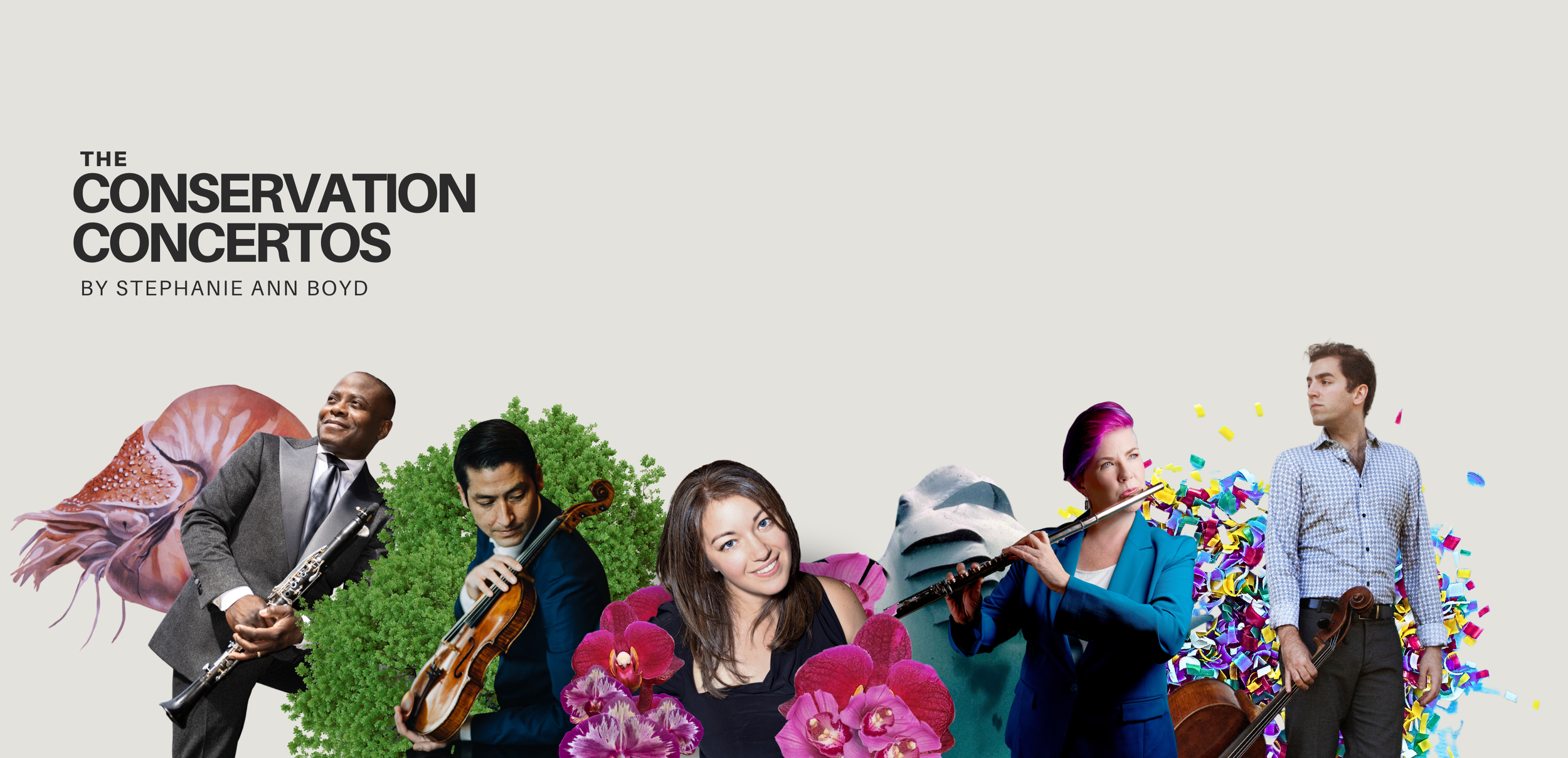
The Conservation Concertos are a set of works for solo instrument and orchestra being written over the next decade, each about a different nearly-extinct flora or fauna, or environmental concern.
Each concerto is about a subject close to its soloist’s heart…
The Conservation Concertos include works…
with Anthony McGill for clarinet + orchestra
about the Nautilus
with Tammy Miller for piano + orchestra
about Nearly-Extinct Flowers
with Masumi Rostad for viola + orchestra
about Pernambuco/Brazilwood
with Tommy Mesa for cello + orchestra
about Plastics
with Tommy Mesa for cello + orchestra
about Plastics
with Marie Bennett for flute + orchestra
about Manta Rays
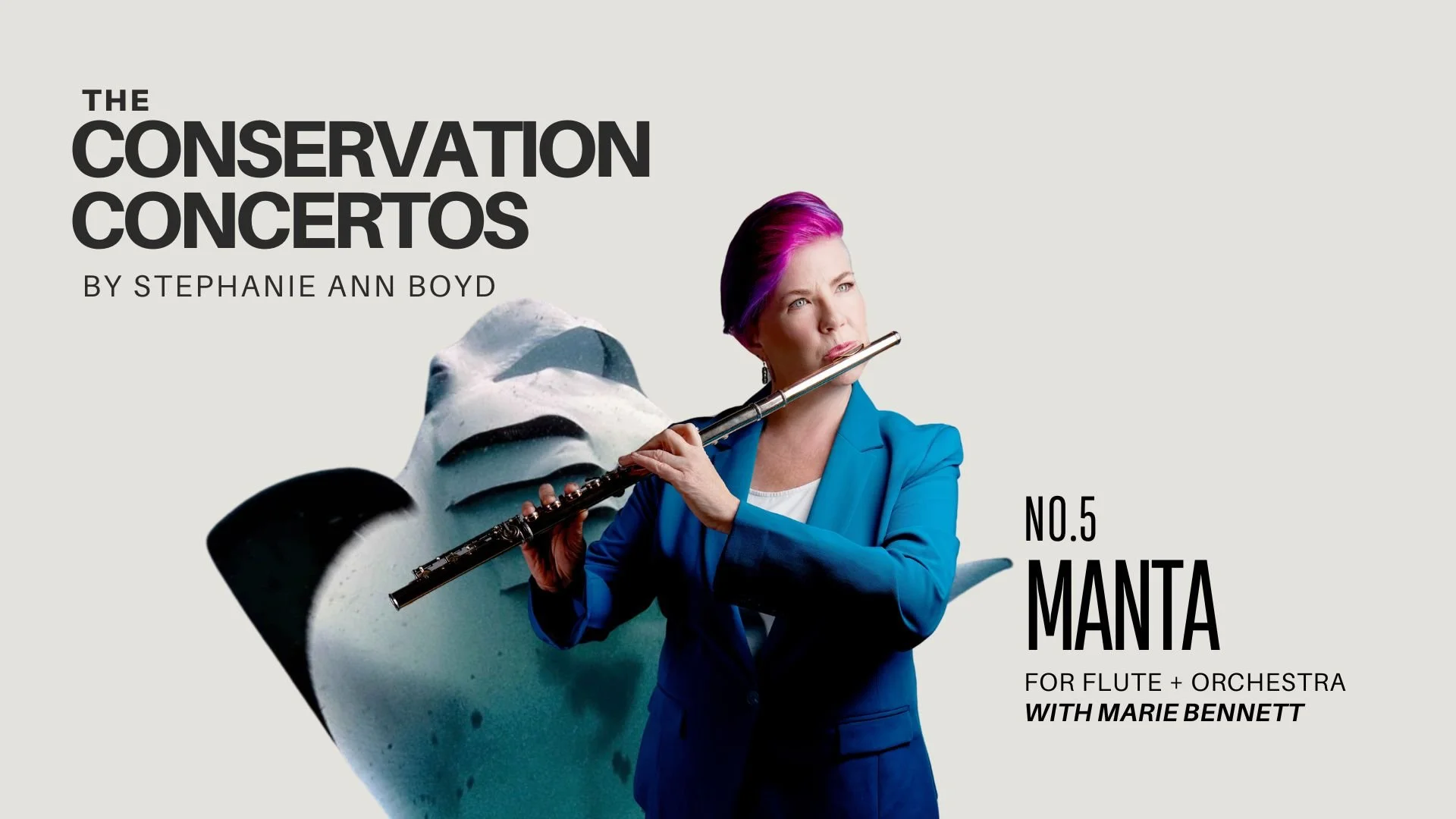
Manta is the fifth chapter of the Conservation Concertos. Written for flutist and climate artist Marie Bennett, the work lets us visit the three known species of Manta Ray. In the first movement, we encounter the gigantic oceanic manta (Mobula birostris) on its great migration, flying in slow motion on an ancient oceanic highway. In the second movement, we take a starlit swim among coral with the reef manta (Mobula alfredi). The third movement is a series of dances celebrating the newest species of manta—just formally discovered in 2025— and the Atlantic manta (Mobula yarae).
In fact, the species is so new that the project was conceived in direct response to this landmark discovery, reflecting Bennett’s ongoing commitment to translating contemporary science into musical experience and is her biggest project to date.
As fishing pressure, habitat degradation, and climate change intensify, manta rays have become powerful symbols of both the vulnerability and resilience of ocean ecosystems.
And in 2025, both reef and oceanic manta rays were uplisted to CITES Appendix I, the Convention’s highest level of protection, effectively prohibiting international commercial trade. In total, more than 70 species of sharks and rays received new or strengthened protections at the conference. These decisions marked a rare moment of global alignment between science, policy, and conservation action—forming part of the context from which Manta was conceived.
Conceived at a moment of rapid scientific discovery and growing conservation urgency, Manta translates contemporary ocean science into musical narrative. The project also reflects recent international momentum for manta protection, including landmark actions taken at CITES CoP20. Through collaboration between composer and soloist, Manta offers a powerful artistic response to vulnerability, discovery, and hope in the ocean.
THE People
Marie Bennett is a Chicago-based flutist and climate artist whose work bridges virtuosic performance, environmental storytelling, and ocean science. Known for her expressive sound and imaginative programming, she performs across the United States and internationally as a soloist, chamber musician, and orchestral player, with a growing body of work focused on ecological witness and endangered ecosystems.
An active commissioner of new music, Bennett has initiated and premiered works that engage directly with climate change, extinction, and environmental memory. She is the founder and artistic director of Extinction Lullabies, a performance and commissioning initiative honoring vanishing species, threatened habitats, and endangered languages through music, poetry, and soundscape.
Bennett’s projects frequently integrate archival and field recordings, spoken text, and multimedia, and she has commissioned and premiered works by composers including Stephanie Ann Boyd, Stephen Lias, Daniel Dorff, Lee Kesselman, and Joshua Rodriguez. A specialist in low flutes, she performs regularly on alto and contrabass flute.
An active collaborator with scientists, explorers, and conservation organizations, Bennett has participated in international climate and ocean expeditions, incorporating firsthand field experience into her artistic practice. Her work has intersected with figures such as oceanographer Dr. Sylvia Earle, whose narration appears in Echoes from the Deep—a work for contrabass flute and whale song commissioned by Bennett and premiered at an ocean conservation gala. In addition to her performance career, Bennett recently retired after three decades of university teaching to focus full-time on large-scale climate-music projects, commissions, and interdisciplinary collaboration.


Michigan-born, Manhattan-based American composer Stephanie Ann Boyd writes music about women’s memoirs and the natural world for symphonic and chamber ensembles. Her work has been performed in nearly all 50 states and has been commissioned by musicians and organizations in 37 countries. Boyd’s five ballets include works choreographed by New York City Ballet principal dancers Lauren Lovette and Ashley Bouder and include a ballet commissioned for the grand opening of the TWA Hotel at JFK Airport. Stephanie’s music has been praised as “a racing, brassy score” (New York Times), “attractive lyricism” (Gramophone), “[with] ethereal dissonances” (Boston Globe), “[music that] didn’t let itself be eclipsed” (Texas Classical Review), and “arrestingly poetic” (BMOP).
Recent commissions and premieres include a work inspired by Betty Friedan entitled Everywoman, with Kennedy Center President Deborah Rutter, mezzo-soprano Michelle DeYoung, and 2022 Indianapolis Competition winner Sirena Huang as soloists and commissioned by the Peoria Symphony Orchestra with George Stelluto; Julia Louisa Esther: a Suffragette Symphony commissioned by the Wyoming Symphony Orchestra with Christopher Dragon, the premiere of which was the subject of a documentary on Wyoming PBS in 2022; Alleluia Olora commissioned by Astral Artists for cellist Tommy Mesa; Aurora, commissioned by the Kurganov-Finehouse Duo, and others.
THE MUSIC
length
19-25 minutes
instrumentation
Version A: 2.2.2.2./2.3.2.1./timp + 4/harp, celeste, solo flute, strings
Version B: strings (min 44331) + percussion + solo flute
three movements :
I. AQUARELLE
We begin on the glittering skin of the sea before descending into the vast depths of the blue cosmos beneath. M. birostris, the giant oceanic manta, flies in breathlike slow motion as their migrations trace the ancient marine highways that bind the oceans together.
II. NOCTURNE
Movement II is slow and hushed, gazing at the constellations beneath the moon — the star-like markings on the bellies of M. alfredi, the reef manta. They gather around the coral, queuing to be gently cleaned by tiny wrasses before slowly drifting into the mesmerizing, ceremonial cyclone of their feeding ritual.
III. DANCE-AUBADE
Movement III begins in a flurry: the cyclone now a spiraled mating-chase. We watch M. yarae, the newest manta species, embody the mythical, mysterious Brazilian mermaid she was named after, acrobatic turns and leaps bursting into a wild, colorful celebration of life that draws inspiration from Brazilian dances like the frenetic Frevo, the “square dance” of the Quadhila, and the Passinho do Romano, a vibrant, cathartic street dance style born right before Andrea Marshall saw M. yarae for the very first time.
The concerto ends in a vibrant dawn, signaling, invoking, and welcoming this next era of connection between human beings and mantas.